
Quick Takeaway:
Ceiling spotlights are the go-to lighting wash solution for most bathroom designs. They provide clear and bright coverage through the whole room. However it’s important to include multiple layers of lighting to avoid the room feeling stark and clinical. Designers work on the basis of these three lighting principles: ambient (general wash), task (focused area) and accent (setting the mood).
Table of Contents
Why ceiling spotlights are popular
The 3 layers of lighting design
Ambient lighting
Task lighting
Accent lighting
How to design a good bathroom lighting scheme
The complete picture
FAQs
You’ve probably noticed that most modern bathrooms come with ceiling spotlights as standard. They’re bright, they’re practical, and they do exactly what they’re supposed to do: illuminate every corner of your bathroom with clinical precision. And that’s the problem, sometimes it can feel a bit much!
At Stone & Chrome, we’ve designed hundreds of bathrooms and we know that good lighting isn’t just about being able to see, it’s about creating a space that feels good to be in. Lighting goes a huge way to achieving this.
Why Ceiling Spotlights Are So Popular
Let’s start with the obvious: ceiling spotlights work. They provide even coverage across your entire bathroom, which means no shadowy corners and no squinting to see what you’re doing. They’re also relatively affordable to install, energy-efficient when you use LED bulbs, and they fit neatly into most ceiling designs without taking up visual space.
For these reasons, spotlights remain the foundation of most bathroom lighting schemes we install. They’re safe and comply with building regulations while being super sleek and stylish. But if spotlights are your only light source, you’re missing out on giving the space a warmer ambiance and feel like part of your home.
The 3 Layers of Lighting Design
Professional designers like us here at Stone & Chrome, work on principles that centre on three distinct types of lighting. They work as the foundation, the focus, and the finishing touch.
Ambient Lighting
This is a general wash of light, and it’s where those ceiling spotlights come in. Ambient lighting provides overall illumination and sets the baseline brightness for your space. In your bathroom, ambient lighting typically comes from ceiling mounted fixtures: spotlights, flush ceiling lights, or recessed downlights. These will evenly distribute without harsh shadows or overly bright patches. You want enough light to navigate safely and see the entire room clearly, but not so much that you feel like you’re on a film set.
Task Lighting
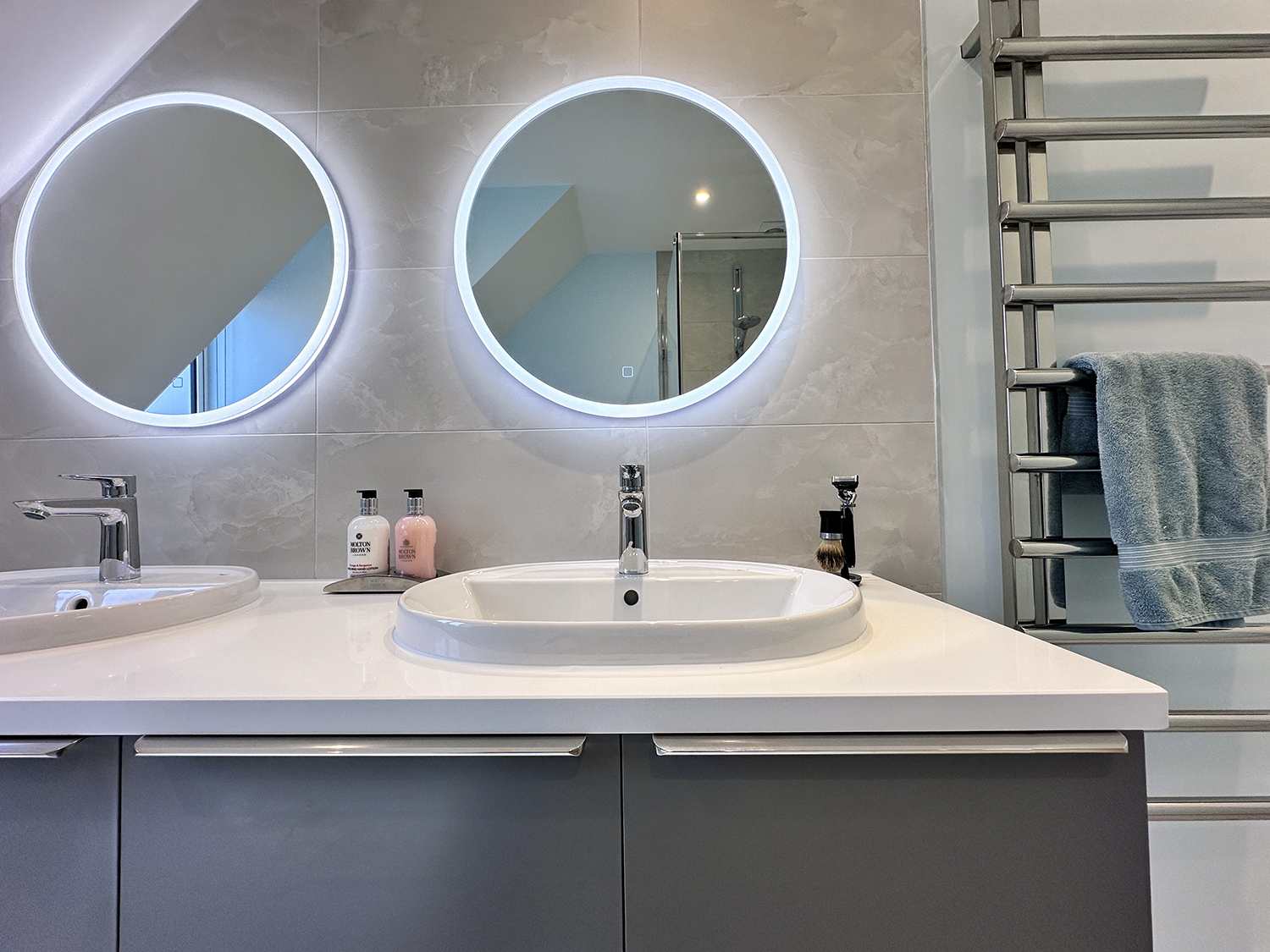
Task lighting, or focus lighting, does exactly what it says on the tin: it helps you complete focused tasks. In a bathroom, that usually means lighting around your mirror for grooming, shaving, or applying makeup.
You need task lighting because ambient lighting alone creates shadows on your face when you stand at the mirror. For that reason, bathroom mirrors with integrated surround lighting are super popular in modern bathroom design. Alternatively, wall sconces either side of a mirror look great in traditional schemes.
Accent Lighting
This is where your room gets its character. Accent lighting creates atmosphere, highlights features, and makes your bathroom more than purely functional.
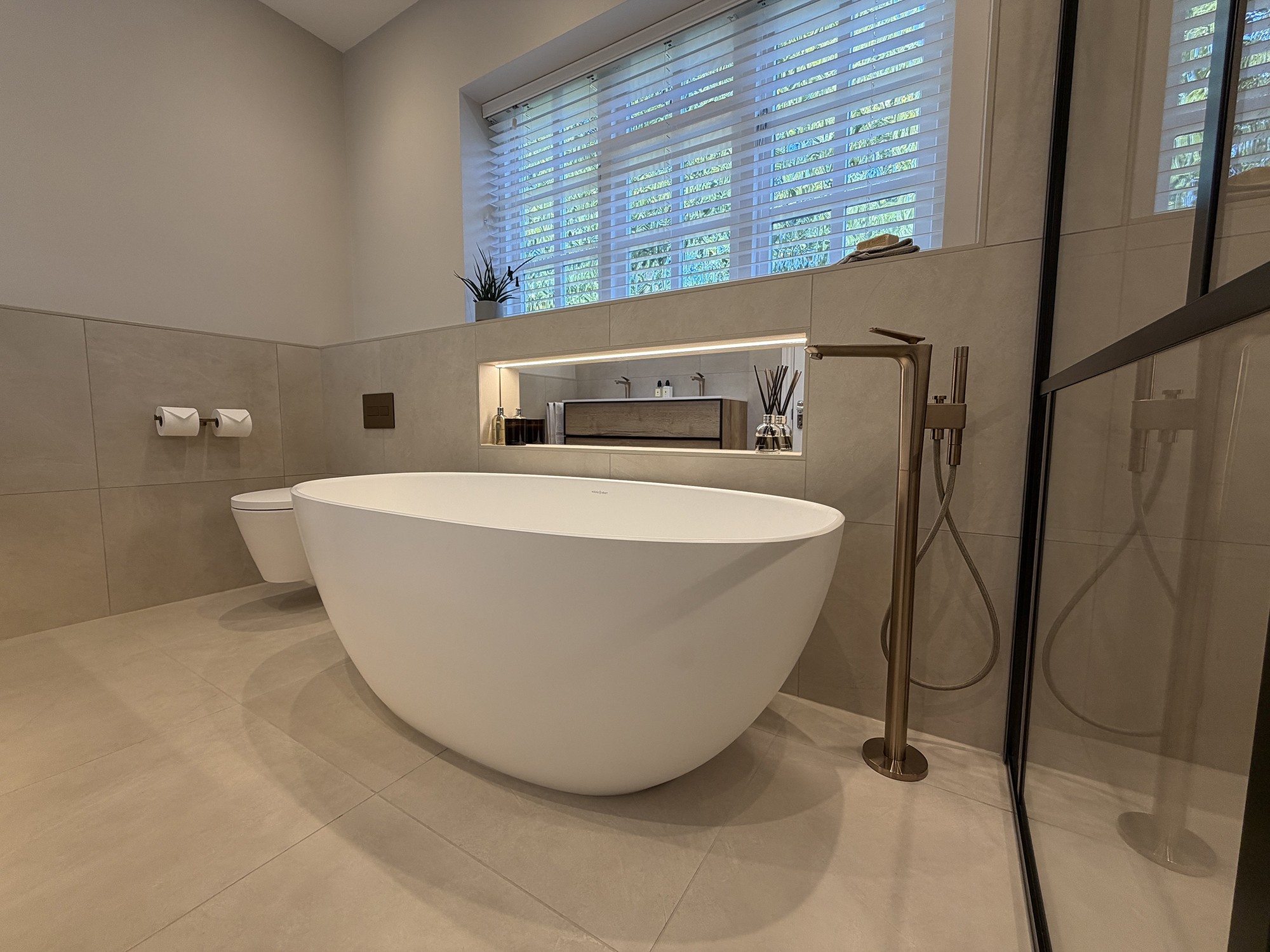
You might use accent lighting to illuminate a feature wall, highlight architectural details, or create a soft glow around your bath. LED strips under floating vanities, backlit mirrors, or small spotlights directed at decorative elements all count as accent lighting.
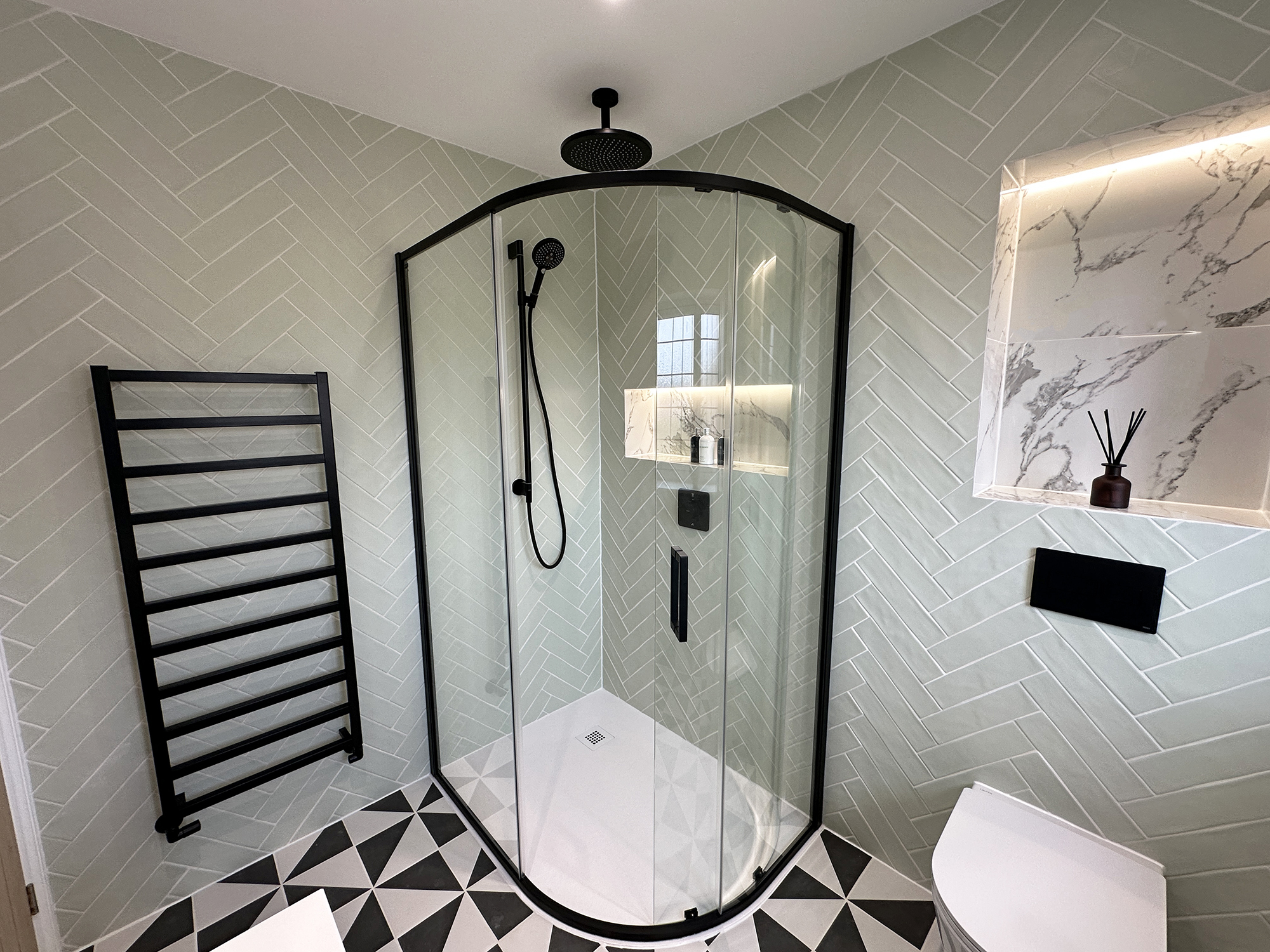
At Stone & Chrome, our signature LED lit recessed shelving has elevated countless bathroom designs. These features are practical and add heaps of character at the same time. You can use coloured, white, or warm lights – or changeable LEDs to get the ultimate flexible mood!
| Lighting Layer | Purpose | Bathroom Examples |
| Ambient | General illumination throughout the room | Ceiling spotlights, flush ceiling lights, recessed downlighters |
| Task | Focused lighting for specific activities | Mirror lights, vanity lights, illuminated mirror cabinets |
| Accent | Atmosphere and highlighting features | LED strips under vanities, lit recessed shelving, feature bath lighting |
How to Design a Good Bathroom Lighting Scheme
The key to effective bathroom lighting is layering these three types strategically. Here’s a step by step guide:
- Start with ambient lighting and calculate how many spotlights you need based on your room size. A rough guide is one spotlight per square metre, but this varies depending on the output of your bulbs and the height of your ceiling. If possible, using a dimmer switch is ideal to maximise control.
- Next, plan your task lighting around the mirror. If you’re renovating, consider an illuminated mirror or mirror cabinet which combines storage with excellent task lighting. Alternatively, install wall lights at eye level on either side of your mirror. Avoid directly overhead lighting around the mirror area, as this creates unflattering shadows.
- Finally, consider where accent lighting could enhance your design. Within a walk in shower enclosure, lit recessed shelving is practical, low maintenance, and looks incredibly stylish. You can use the same principle to accent a feature or artwork elsewhere in the room, too. A warm glow under cabinets or floating vanity create a sense of depth in the space.
The Complete Picture
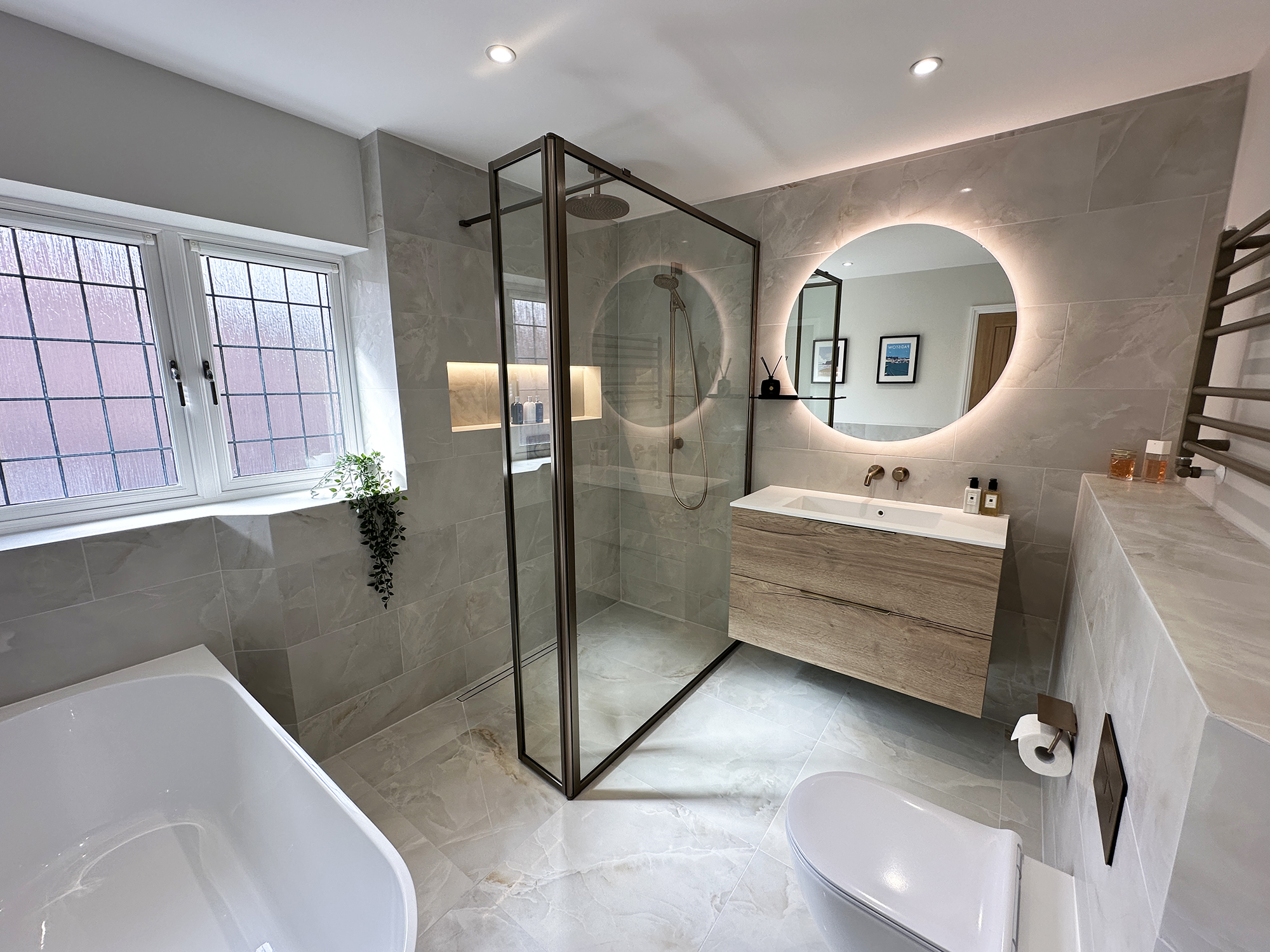
So, clearly while ceiling spotlights are a practical and effective way to light a bathroom, they are by no means a stand alone solution. Bathroom lighting is more complex than picking one fitting, and plays a huge part in creating an overall room design.
As bathroom designers and installers, we at Stone & Chrome have perfected the balance of lighting design within a multitude of concepts from traditional to contemporary. By layering ambient, task, and accent lighting, we create spaces that work for every scenario. Come and visit our showroom and talk to our designers to get an idea of how your space could be transformed.
FAQs
How many spotlights do I need in a standard bathroom?
For a typical bathroom (around 5-8 square metres), you’ll usually need 4-8 spotlights depending on the wattage and beam angle. LED spotlights with wider beam angles cover more space, so you might need fewer. Plotting the position of spotlights is something that we can deal with as part of your bathroom design.
What colour temperature works best for bathroom lighting?
For ambient lighting, 3000-3500K (Kelvin) is a warmer white that is more cosy. Task lighting benefits from being brighter, so 4000-5000K. Then, accent lighting is a bit more down to your preference and the concept for the room – you might even want coloured hues.
Is adjustable lighting worth it?
We’d say that it’s always worth having some amount of adjustable lighting in your bathroom. You use the space at different times of day, experiencing different levels of natural light. So for task lighting especially adjustable functionality is well worth it.